Latest News
Terrorists Kill Six, Including Soldier, In Plateau; Kaduna Communities Report Renewed Attacks


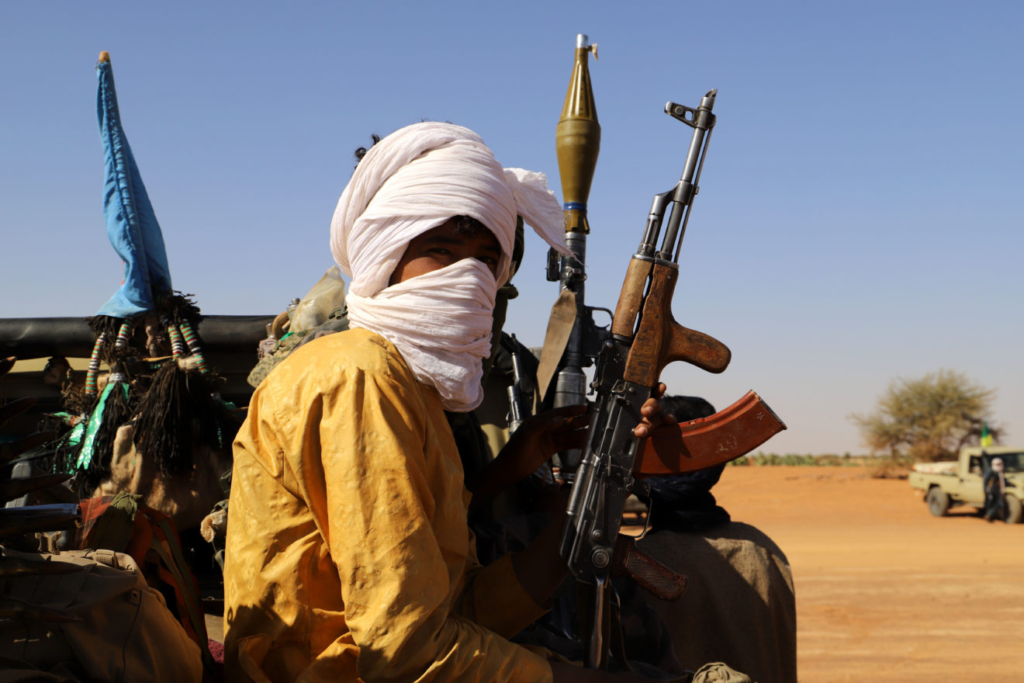
At least five residents and one soldier were, reportedly, killed on Monday when suspected terrorists launched coordinated daytime attacks on Zurak and Sabon Gari communities in Bashar district of Wase Local Government Area of Plateau State.
Residents also reported that three soldiers providing security in the area were missing following a gun battle with the attackers.
Local sources said the assailants, who arrived in large numbers on motorcycles, first invaded Sabon around 4pm, caused widespread panic and forced residents to flee to neighbouring villages.
A youth leader in Wase, Shapi’i Sambo, confirmed the incidents, on Tuesday, stating that the remains of the slain soldier have been moved to Jos earlier in the day.
Another resident, Jibrin Isa, from Zak community, described the assault as overwhelming. Isa explained that the attackers first targeted a military checkpoint in Sabon Gari before moving into the commercial centre of the community.
He said, “They looted almost all the shops and took away food items and other valuables. After Sabon Gari, they moved to Zurak and again attacked the military checkpoint. Five residents and one soldier were killed, and three soldiers are still missing.”
Isa added that Zurak had been completely deserted as residents fled for safety.
A military situation report seen by THISDAY indicated that troops had earlier received intelligence that bandits had mobilised about 200 motorcycles in preparation for an attack in Wase Local Government Area.
According to the report, troops were placed on red alert before the attackers advanced toward Sabon Gari about 5:03pm, firing sporadically.
Soldiers mobilised to confront them, but while troops were engaging the attackers in Sabon Gari, the bandits regrouped and launched a second assault on Zurak.
Troops responded with “superior firepower,” neutralising three bandits and recovering two motorcycles, two AK 47 magazines and 13 rounds of 7.62mm ammunition.
The attackers were reportedly seen evacuating their casualties across a river line near Zurak.
The report confirmed the death of one soldier, identified as Cpl. Oladipo Adekunle, whose rifle and an RPG tube were taken by the fleeing assailants. Two other soldiers—Tpr. Aminu Rasheed and Pte. Aliu Yakubu—were declared missing in action. Search and rescue operations were still ongoing.
The military stated that the attacks reflected an emerging trend in which armed groups launched feint operations to distract security forces before striking their main targets.
It also warned that criminal elements fleeing other conflict zones migtht be seeking refuge in the forested areas spanning Wase (Plateau), Alkaleri (Bauchi), and Karim Lamido (Taraba).
Troops from Operation Enduring Peace (OPEP), in collaboration with 33 Brigade and Operation Whirl Stroke were expected to launch offensive operations in identified hideouts in the coming days.
Kaduna Communities Cry Out over Renewed Bandits Attacks, Abductions
Communities in Lere and Birnin Gwari local government areas of Kaduna State have cried out over renewed attacks and kidnappings by bandits.
In separate press statements, on Tuesday, in Kaduna, the communities called on the Kaduna State and federal governments to take adequate steps to protect citizens from frequent killings and attacks by bandits.
Addressing a press conference in Kaduna, President of the Akurmi Development Association (AKURDA) in Lere Local Government Area, Yakubu Maigamo, said no fewer than 12 residents were killed by bandits in a series of attacks, while 59 others abducted since October 2025 were still in captivity.
Maigamo painted a grim picture of life under siege, saying the wave of violence across Akurumi settlements in the last four months has pushed the people to the brink.
He lamented the seeming neglect of the community in the face of repeated attacks.
“Are we still part of Nigeria? Or have Akurmi lives become disposable?” he asked.
Maigamo said the attacks had been systematic and devastating, affecting several communities across Lere.
He cited Karku Ningi in Kauru Local Government Area, where four persons were killed and nine kidnapped during an October 2025 raid.
He also listed Gidan Waya, Jan Tsauni, and Mai Yamma in Lere Local Government Area, where another four people were killed and 13 abducted in November 2025.
He said more abductions and killings were recorded in Majagada, Gurza, Garun Kurama and Biman Kurama communities within the period under review.
Maigamo disclosed that many of those abducted since October last year were still in captivity, with families forced to sell foodstuffs, such as grains and other farm produce meant to sustain them during the year in order to raise money for ransom.
He said the bandits operated with “absolute impunity”, adding that they strike repeatedly without resistance or consequence.
While acknowledging the efforts by the federal and Kaduna State governments to address the security challenges, the community leader said the response had been grossly insufficient to stem the tide of attacks on Akurmi settlements.
He said the continued silence and slow response from the authorities had emboldened the attackers and deepened the people’s sense of abandonment.
The association appealed to Governor Uba Sani to order the immediate and permanent deployment of security personnel to Akurmi communities to prevent further attacks.
COAS: Terrorists, Criminals Exploiting Gaps, New Technologies to Destabilise Nigeria
Chief of Army Staff (COAS), Lieutenant-General Waidi Shaibu, has said Nigeria’s security challenges are increasingly shaped by a rapidly evolving global threat environment, where traditional state-centric warfare has given way to complex intra-state conflicts driven largely by non-state actors.
According to Shaibu, terrorists, insurgents, bandits, cybercriminals, and transnational organised crime networks now dominate the security landscape, deliberately exploiting governance gaps, societal vulnerabilities, and emerging technologies to perpetrate atrocities and undermine state stability.
Shaibu stated that the asymmetric threats thrived on adaptability and anonymity, often deliberately targeting civilians in order to erode public confidence and weaken state authority.
He made the observations while addressing participants of National Defence College (NDC), Nigeria, Course 34, in Abuja, on Tuesday.
Speaking on the topic, “Combating Asymmetric Threats to National Security in Nigeria: The Nigerian Army in Perspective,” the COAS stressed that sustainable peace could not be achieved through military action alone.
He emphasised that enduring security must be underpinned by effective governance, credible justice delivery, and inclusive socio-economic development.
Reaffirming the commitment of the Nigerian Army to confronting evolving security threats, Shaibu said the service had adopted a dynamic, intelligence-driven, and technology-enabled approach to counter asymmetric threats to national security.
In response to the changing threat spectrum, he explained that the army had recalibrated its operational doctrine, force posture, and employment of capabilities through a comprehensive multi-domain strategy.
He said the strategy combined decisive kinetic operations with intelligence fusion, inter-agency collaboration, joint operations with sister services, and sustained international partnerships.
Shaibu stated, “Asymmetric threats thrive on adaptability, anonymity and the targeting of civilians to erode public confidence and state authority.
“Our response must, therefore, be equally adaptive, proactive, intelligence-led and collaborative, leveraging military power alongside technology, whole-of-government coordination and strategic partnerships.”
The COAS further explained that Nigerian Army operations across the country’s geo-political zones had been deliberately tailored to reflect prevailing threat dynamics.
In the North-east, he said sustained counter-insurgency operations had continued to degrade terrorist capabilities through offensive manoeuvres, intelligence-driven strikes and population-centric stabilisation efforts.
In the North-west, he stated that intensified joint operations had placed bandit groups under sustained pressure, disrupted their logistics and financing networks, and improved the protection of vulnerable communities.
Similarly, stabilisation operations in the North-central region had focused on area domination, protection of civilians, and containment of communal and militia-related violence, Shaibu said.