Latest News
Senate Grills Accountant-General Over N28tn Revenue, Zero Capital Allocations


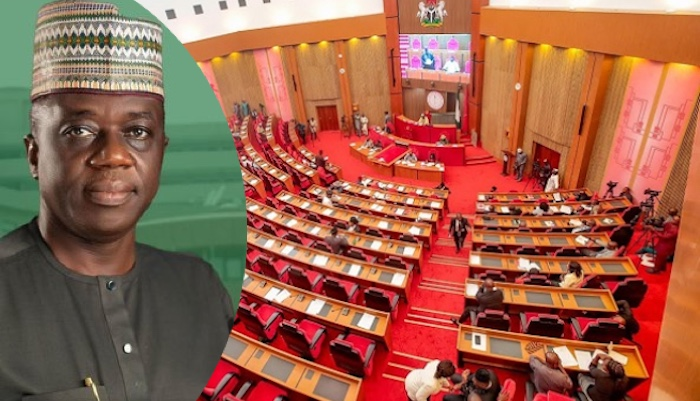
The Senate on Thursday launched a blistering attack on the Accountant-General of the Federation (AGF), Dr. Shamsedeen Ogunjimi, over zero capital allocations to several Ministries, Departments and Agencies (MDAs) in the 2025 budget and mounting complaints of unpaid contractors across the country.
At an explosive budget defence session of the Senate Committee on Finance, lawmakers accused the Office of the Accountant-General of frustrating budget implementation, presiding over a controversial Centralised Payment System, and failing to explain how N28 trillion reportedly generated by revenue agencies has not translated into capital releases.
From the opening remarks of the Committee Chairman, Senator Sani Musa (Niger East), it was clear the AGF was in for a tough day.
Musa bluntly told the AGF that his office’s disposition to the committee was “unfriendly” and must change in the interest of Nigerians.
“We are not going to take your budget until we are satisfied that your office is ready to do things that will make things work for Nigerians,” Musa declared.
He identified the envelope budgeting system as a major concern, arguing that the yearly model has failed to deliver results and should give way to a performance-based framework.
“One of the issues that must be urgently resolved is the envelope budgeting system being used by the federal government on a yearly basis but not producing desired results.
“We need to consider an alternative model like performance-based budgeting,” he said.
But it was Senator Danjuma Goje (Gombe Central) who amplified the mood of the chamber, describing the state of budget implementation since 2024 as “embarrassing.”
“Here at the National Assembly, we have never seen contractors bombarding us on a weekly basis for intervention over non-payment of executed contracts,” Goje said.
He questioned the narrative that the removal of fuel subsidy and the harmonisation of the foreign exchange market would significantly boost government revenue.
“The impression given to us and Nigerians is that with subsidy removal and forex harmonisation, there is more revenue.
“Where is the money now? Why are contractors owed? And why is there zero allocation for capital votes of most of the MDAs in 2025?” he asked.
According to him, the situation was both baffling and damaging to the credibility of government.
Senator Muntari Dandutse (Katsina South) raised the stakes further, demanding an explanation for the reported N28 trillion generated by revenue agencies.
“We were told that N28 trillion was generated, yet 85 per cent of contractors are being owed and most MDAs have zero allocation in their 2025 capital budgets. What happened to the N28 trillion?” he queried.
Dandutse also took a swipe at the Centralised Payment System introduced by the federal government, describing it as deeply flawed.
“The system is very compromised and seriously affecting the integrity of government,” he said, arguing that it has compounded payment delays rather than resolving them.
Other senators, including Abdul Ningi (Bauchi Central), Asuquo Ekpenyong (Cross River South), Adams Oshiomhole (Edo North), Aminu Abbas (Adamawa Central), and Patrick Ndubueze (Imo North), made forceful interventions.
They urged the AGF to advise President Bola Tinubu to guard against what they described as possible internal sabotage undermining fiscal operations.
The lawmakers insisted that the combination of unpaid contracts, stalled capital projects and zero allocations to MDAs painted a troubling picture of the 2025 budget framework.
Responding to the barrage of criticisms, Ogunjimi defended his office, attributing much of the crisis to indiscriminate contract awards by MDAs without secured funding.
According to him, the practice of awarding contracts without confirmed cash backing created the current backlog of unpaid obligations, prompting the federal government to issue a directive banning MDAs from awarding contracts without available funds.
“Yes, as the Accountant-General of the Federation, my office is expected to disburse funds to relevant agencies at the appropriate time, but that can only be done if the funds are available. I must have the funds before I can disburse,” he said.
The AGF also addressed concerns over the Centralised Payment System, acknowledging that some operational challenges were not initially envisaged but insisting that corrective steps were underway.
“Though challenges are being faced with the operation of the Centralised Payment System, they are being addressed for seamless operation,” he assured.
Ogunjimi further reminded lawmakers that the controversial “Ways and Means” financing used in the past to plug funding gaps was no longer being deployed.
“I also want to remind us that ‘Ways and Means’ used in the past for such funding is no more, for the good of the nation’s economy,” he said.
His explanation, however, did little to calm the stormy session, as senators maintained that Nigerians expected tangible results, not technical justifications.
With tensions running high and key questions unresolved, particularly over the alleged N28 trillion in revenue and zero capital allocations to MDAs, the committee eventually moved into a closed-door session with the AGF for what members described as “further critical engagement.”
The outcome of that session is expected to determine the fate of the Accountant-General’s budget proposal and could shape the broader debate on fiscal transparency and budget performance under the current administration.