







Opinion
The Obi-Kwankwaso Realignment: Can the NDC Break the Two-Party Hegemony?

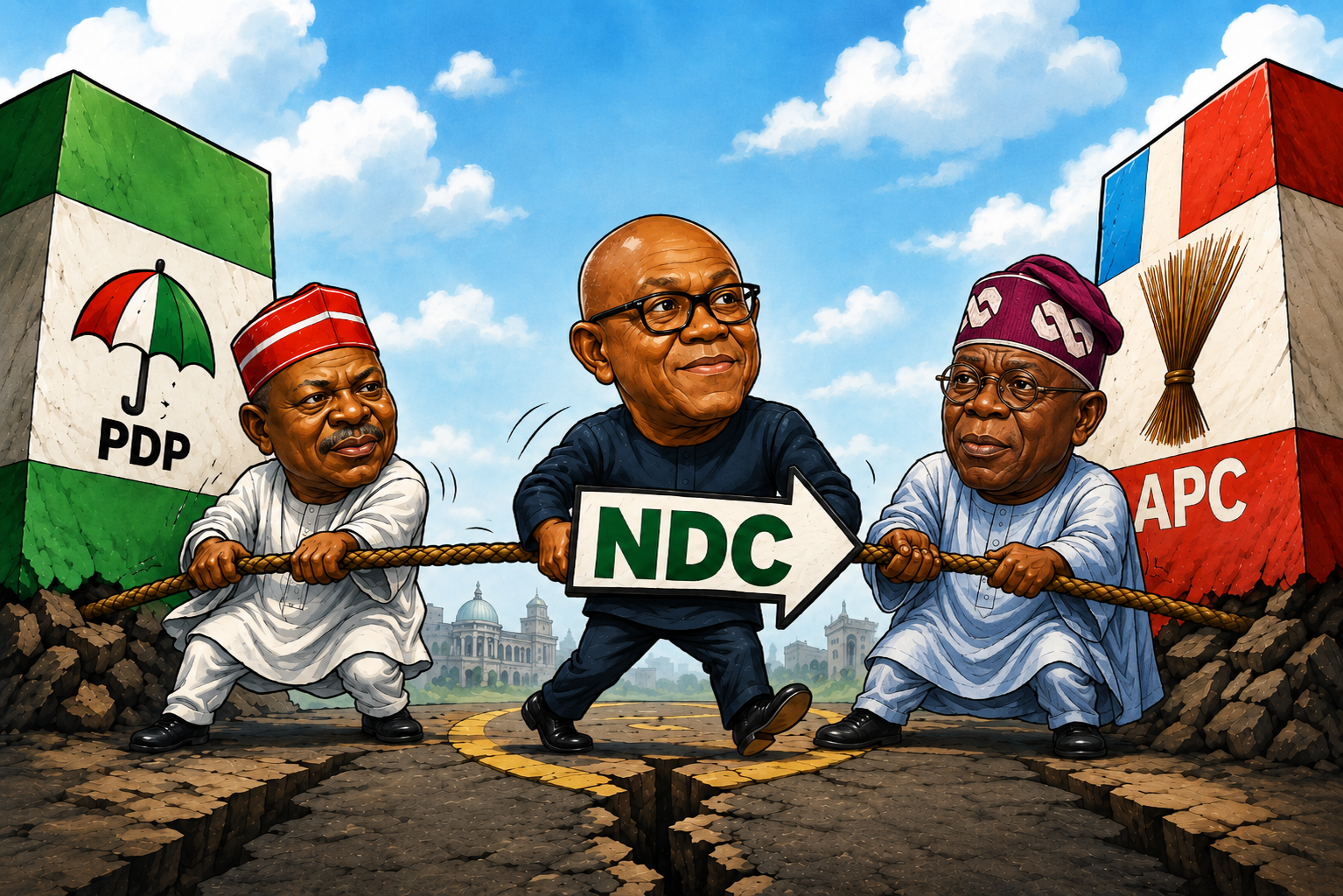
The decision by former Labour Party presidential candidate Peter Obi and former Kano State governor Rabiu Musa Kwankwaso to align under the platform of the Nigeria Democratic Congress may prove to be the biggest political disruption Nigeria has witnessed since the merger that birthed the All Progressives Congress in 2013. For years, Nigeria’s political space has largely revolved around two dominant forces, the APC and the Peoples Democratic Party. While smaller parties have emerged periodically, most lacked either national spread, financial muscle or grassroots credibility. The NDC appears determined to challenge all three limitations at once.
Peter Obi remains one of Nigeria’s most powerful political brands. His appeal extends beyond traditional party loyalty. To many young Nigerians, he represents prudence, accountability and a break from the wasteful political culture that has defined governance for decades. His rise in 2023 was built largely on hope-driven mobilisation from frustrated youths who wanted something different. However, hope alone was never enough. That was one of the Labour Party’s biggest weaknesses during the 2023 election. It had digital enthusiasm but lacked widespread grassroots infrastructure, especially in Northern rural communities where elections are often won long before social media trends begin. That is where Kwankwaso changes the equation. Through the powerful Kwankwasiyya political structure in Kano and parts of Northern Nigeria, Kwankwaso brings what Obi lacked in 2023, a tested political machinery with loyal foot soldiers. The merger of the Obidient movement and Kwankwasiyya movement creates what many political observers now describe as the “OK Movement,” a coalition that could significantly alter the mathematics of 2027.
The implications for President Bola Ahmed Tinubu and the APC are significant. The South-East and South-South are likely to remain strongholds for Obi. The North-West may become more competitive because of Kwankwaso’s influence, while the North-Central could emerge as the decisive battleground where issues of insecurity, inflation and unemployment may shape voting decisions. Yet, the South-West remains difficult terrain for the opposition because of Tinubu’s deeply entrenched political network. Still, the NDC’s biggest threat may not come from the APC.
It may come from itself. Nigeria has seen many political coalitions collapse under the weight of ego battles, internal litigations and poor organisational discipline. The NDC must avoid becoming another temporary alliance built around personalities rather than institutions. It must build strong state chapters, credible candidate structures and effective polling unit representation nationwide. Without that discipline, it may repeat the same mistakes that weakened Labour Party’s challenge in 2023. The real significance of the Obi-Kwankwaso alliance is not simply whether it wins in 2027. It is that, for the first time in years, Nigeria’s two-party dominance is facing a genuine threat from a coalition with both emotional appeal and political structure. That alone should make the ruling establishment nervous.
Get social! follow us for more news
Related